Christmas Trees | Our Story | Links | Tree Stand | Home
"Sorry No Pets!"
Meet Our Barnyard Buddies
As the population becomes more and more urbanized, fewer individuals recognize where the items on the store shelves come from or what a huge process is involved in getting it there. It has not been too many years ago that folks depended on what was available directly at home or in the area immediately surrounding it. This was especially true of their livestock, from which came food, clothing, shelter, heat, beverages, medicines, and more.
All of our livestock are traditional breeds which could have been found at many homes in this area. The animals you see today have actually become our pets which, although it is sometimes most tempting, will not look back at us from the supper table.
Even if they are considered “pets” by those of us who feed them daily, PLEASE keep in mind that they have the ability to, and will, inflict serious damage by biting or pecking.
This could make for a not so fun day when you visit. BE SURE to review our “Conduct Policy” concerning our animals with all those in your party!
Closed daily at 4:30 pm (Gates close at 5:15 pm)
Hogs
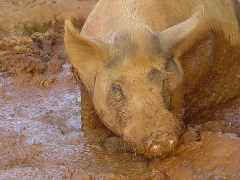
As many of you know, we lost ‘Bobby the Hog’ a while back. The 700 lb. gentle giant has been missed a great deal by those who had come yearly to visit with him. So…
After completely redoing his pen (we are still waiting on satellite installation) we went out and found a couple of piglets. They are sisters who are just a wee bit full of themselves. They are a mix breed – that being Hampshire and Yorkshire. We do not expect them to be as large as Bobby – you know they have to watch their
figures – but what they lack in size is more than made up for with just good old-fashioned girly stuff.
One thing does remain the same and that is we want you to visit but we want all to be cautioned NOT to place hands inside of fence (this includes you guys). Hogs are not mean but are curious . And since our hogs are of the female side this is double trouble. And we do not want you to loose a figure or hand as we are particular as to what we feed our hogs.
By the way, there was somewhat of a debate as to what they would be named. My wife thought Olivia and Oreo would be “sweet”. I on the other hand suggested Lunch and Supper. Sounded more realistic.
So…Tell Olivia and Oreo “Hi” when you are this way.
Chickens
Chickens-We have a variety of chicken breeds and body types. Types are
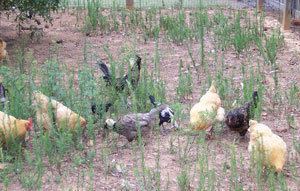
usually determined by a body feature. “Heavies” are just that but are good layers. “Fancies” are usually the showiest due most often to plumage. Bantams are small but usually very colorful and always on the go. Most of our chickens lay brown eggs, which contrary to popular opinion, are no more healthy than white eggs. What eggs we do not use here are sold locally.
Donkey
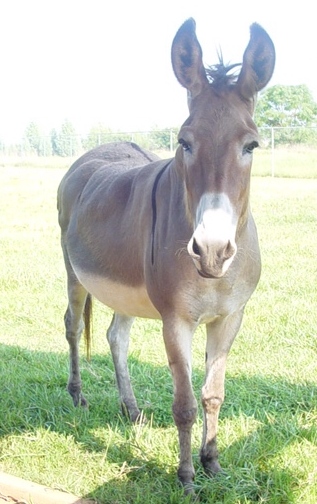
Donkey-Holly is our full-size Sicilian donkey. She likes to gently rest her head on your shoulder to get your attention. She loves carrots and apple slices as a treat and has been known to go in search of these by trying to stick her big nose in the pocket she thinks contains the prize. Holly’s main job – other than being a great and loyal friend- is to protect the goats from dogs, coyotes, and other predators. Where you find our goats, you can be sure Holly is close by. We look forward to enjoying Holly’s antics for a long time as donkeys may live 45-50 years.
Peafowl
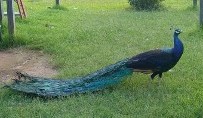
Peafowl- Our peafowl are a variety called “black shoulder”. You will see one male peacock who is the most colorful, named NBC II. There are three female peahens. They are known as NBC’s affiliates. From spring through summer NBC will sport spectacular tail feathers which he is constantly lifting and spreading in an effort to impress his affiliates. His total fan width is 9-10 ft. and is a sight to behold! Unfortunately, he drops these feathers in the late summer each year but immediately starts to grow new for next year. We often sell these beautiful feathers to florist. Their feathers, and those of some chickens, are also in demand by fishermen to use to tie flies.
Ducks
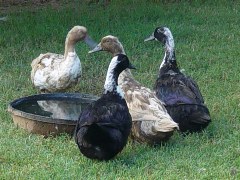
Ducks-At one time we had a total of 15 ducks representing 3 varieties, but due to repeated visits by a pair of owls we were reduced to just 3 ducks. The owls were finally humanely caught and then released some distance from the farm unharmed. Fortunately, we were soon surprised one Sunday morning to find a parade of 10 tiny ducklings obediently following their Mom to the water, with Dad bringing up the rear. After watching these ducklings being raised, I have decided that we humans could take some lessons. Our “quackers” are humorous, as well as interesting, to watch.
Goats
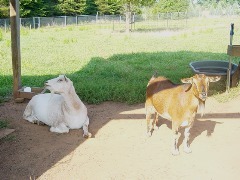
Our goats were given to us by the late Ms. Jerry Munns, after our goats were killed by dogs. Their breed is called alpine. (You might note there are over 200 breeds in the world.) They are females, which are called “does” in the goat world.
They can usually be found somewhere close to Holly the Donkey, as Holly the Donkey is their main protector. After they get to know you they will spend much of their time trying to get their nose in your pocket in search of treats, climbing into or on top of your vehicle, trying to eat something they should not (like the windshield wipers on the truck) or just plain ignoring you.
Goats were the first domesticated animal used for food and drink, with that taking place between 7000 and 10000 BC. More people eat goat meat and drink goat milk than any other animal in the world.
Goats live 8-10 years and can weigh 22- 380lbs. They have no front upper teeth and 4 stomachs. Nearly every part of a goat is or can be used for something- such as food and drink, clothing, shelter, shoes, lacing, weapons, and much more.
Ours seem most adept at being used as lawn mowers and brush clearers. One of our ways to go green.
Turkeys—We started with turkeys that most people are familiar with, even though they don’t know it—the broad-breasted bronze. These birds are colorful, grow very fast, become huge, and are dumb as dirt. Breeding them to grow fast and heavy resulted in problems that were good for the market but bad for the bird. The most notable being they can get so heavy that often their legs can not support them, thus they can not walk, or they have terrible feet problems.
We now have a breed known as bourbon red, which you might guess, came from Kentucky. It is very hardy and has excellent meat. The disadvantage is it can be very aggressive and does not get large as quickly as the broad-breast. It is some what smarter but you have to look! Used on farms years ago because it was so hardy, it was all but abandoned in favor of the fast to market broad-breasted bronze. Today it is enjoying a nice resurgence and should become more visible.
Goose—We obtained our goose in spring of 2008 but were notreal sure of what to do with her---yes
she has proven to us that she is a female. Because she is a type who likes to be in a field chasing bugs, etc, we put her in with Holly and the goats. The goats were not too sure about this hissing thing who got sooooo big when she spread her wings, so they kinda stayed at a distance but NOT HOLLY. They became great friends with the goose following Holly everywhere and often resting between her feet. Water is not clean for long as the goose will get in with it regardless of the size of the container. A name is still up for grabs---one calls it “Charlotte” and the other “AFLAC!” Let us know what you think.
Golfs---Yes, you read it correctly. We DO have a rare golf nest under protection at our farm. For those of you unfamiliar with golfs and golf hunting, we have posted information by their nest. Consider yourself special if an adult golf makes itself visible during your visit!
ANIMAL WELFARE ACT CERTIFICATION
May-Lan Tree Plantation is pleased to have met licensing requirements under the USDA Animal Welfare Act (AWA) and, as of 2005, is a Class C Exhibitor, certificate number 56-C-0144.
To comply with the AWA, May-Lan Farms maintains its facility and animals according to AWA regulations and standards. We also keep current and accurate records on all our animals and have a written program of veterinary care, as provided by Cleveland Park Animal Hospital, Greenville, SC. We also meet, or exceed, requirements as to maintaining the health, safety, and welfare of our animals and our visitors.
May-Lan Tree Plantation is proud to comply with the AWA and the USDA in its efforts to protect livestock and wildlife from inhumane treatment.
To learn more about the Animal Welfare Act, contact the USDA, Marketing and Regulatory Programs, Animal Care, 920 Main Campus Dr., Raleigh, NC, 27602-5213.
Barnyard Buddies |
Calendar |
Directions |
Pumpkins Ideas | Tours

May-Lan Tree Plantation
156 Cooley Bridge Road
Pelzer, SC 29669
(864) 243-3092
Store Hours: (Seasonal)
@
2004 - 2010 May-Lan Tree Plantation
Developed and maintained by Spalding Computer
Services
Last Update: 11/07/2014